
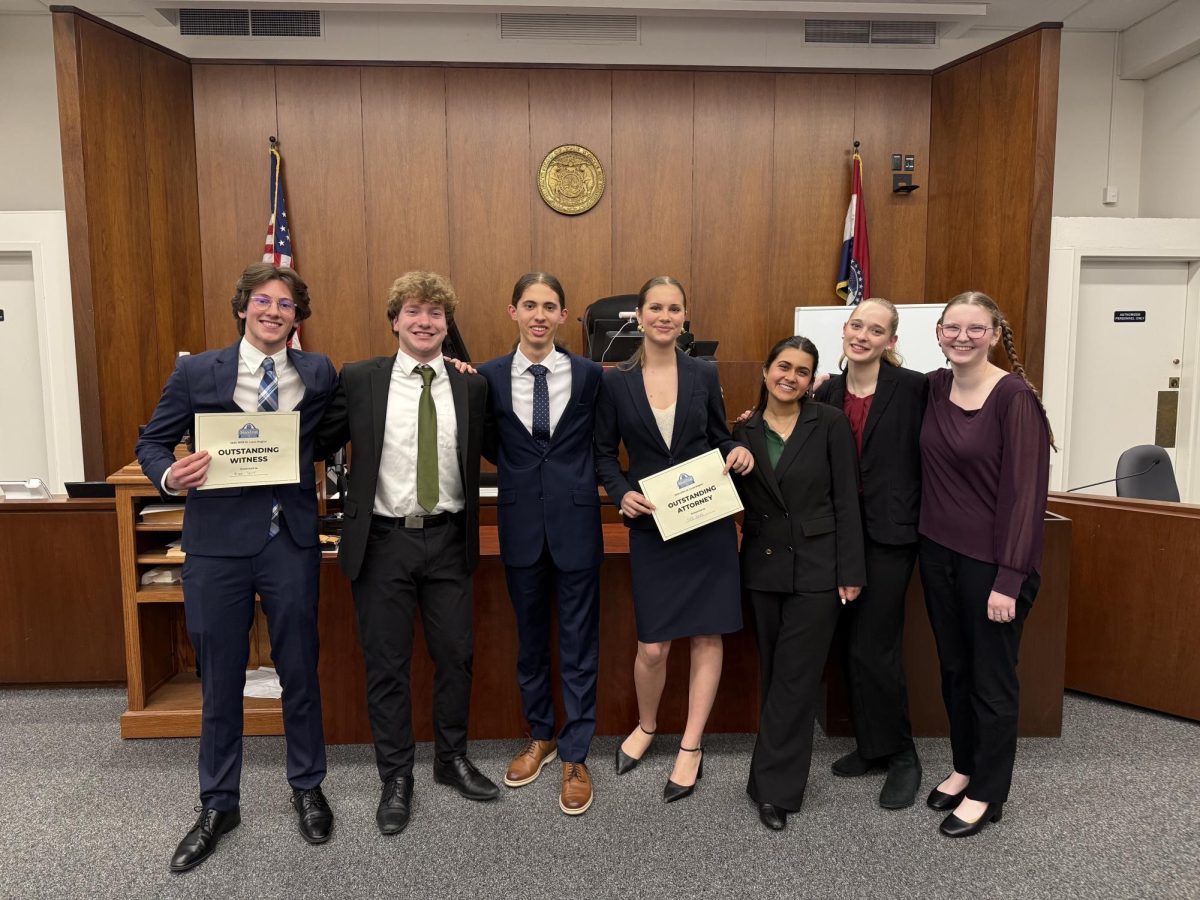
Banging gavels, intense questionings, emotional testimonies, cross examinations, objections and a witness stand. Most people see these as nothing but the components of the high-stakes, consequential court trials that occasionally show up on TV or in the news. However, for some students, these things fill their nights and weekends as they simulate the proceedings of a court case through the mock trial club. This club gives students the opportunity to engage in essential parts of a trial, acting as witnesses or attorneys in a competitive environment. Individual club members’ performances are ranked on scales of one through 10 by volunteer legal professionals to determine if the team wins or loses. As March starts, the transition from the normal season to higher-level trials has begun, meaning the repeated weeks of studying the case, memorizing roles and preparing plans of attack since October have reached their climax as the team makes its way towards the regional, and possibly state, competitions.
Lucas Ravenscraft, social studies teacher and mock trial sponsor, said he has been involved with the club for 11 years. He said that he was first contacted about coaching the KHS team due to his previous experience as an attorney. During his time as a sponsor, the team has finished in the top eight 10 times and won state three times.
“We have a huge advantage in that every single coach involved with the Kirkwood mock trial team [was] also an attorney, [which] most schools do not have,” Ravenscraft said. “[Our team is] seen as one of the best programs in the state; we’re kind of a powerhouse.”
Ravenscraft said he expects the team to be in the running for a state title this year, and said he believes the students going to state are both well experienced and committed to their roles on the team. One of these students, Evie Elias, junior and mock trial attorney, was on the state team last year and said the preparation for trials becomes more focused and specialized as the team’s size decreases.
“As you move on to regionals and state, everyone just gets so focused and locked in [on our] shared goal,” Elias said. “It’s a team effort, and when you win, it’s a really amazing thing to be able to celebrate with the team who helped get you there.”
In order to make it to regional competitions, students must not only be skilled enough to win the preceding trials, but also have a strong record and commitment for the club sponsors to select them for the final team of around 14 attorneys and witnesses. This process of choosing competitors can sometimes result in unexpected changes. Trip Nieman, junior, said he had to switch from his previous attorney role to witness in order to compete in regionals.
“As an attorney, [I had] to understand the witness and understand all the elements of [their character], and then I became them,” Nieman said. “[Going to regionals] is a great opportunity. It allows me to keep practicing and learning with our [team], and it’s really fun to do.”
Both Elias and Nieman said this extracurricular has educated them on the proceedings of the legal system and skills of lawyers, and it’s even inspired the possibility of a future in law for Nieman. Ravenscraft also said the club’s nature serves as a way for students to improve public speaking, acting and intellectual skills.
“It is a club that requires a lot of time and effort outside of school, so it tends to attract students who are interested in putting in work and taking on a competitive [and academic] team,” Ravenscraft said. “Those are some of the most interesting, intelligent [and] fun students to work with. We’ve got a really good shot to go all the way this year.”